|
 |
 |
 |
|
£12.99 |
| John Adair has
transformed the understanding of how leadership works with
his pioneering book Not Bosses But Leaders. Now he returns
with a new title that explores in an authoritative way exactly
what we know about leadership and leadership development.
There is a revolution underway. We are moving - rapidly in
some areas, slower in others - from management to business
leadership. As the market for good leaders who can achieve
results increases so-called leadership development programmes
have proliferated. Many of these are old management development
programmes renamed, and others are full of confusing theories
and unproductive approaches. This ground-breaking new book
aims to set the record straight. It looks at the body of knowledge
on leadership, identifies the seven key principles of leadership
development, and answers key questions on how to select, train
and educate leaders at the level of team, operational and
strategic leadership. A vital addition to the debate on leadership
from a true expert, this book also considers the global challenge
and long term issues involved.
Paperback – 250 Pages (8 March, 2006)
ISBN: 0330344757
How to Grow Leaders stresses that developing leaders is a
bit more difficult than merely training them in short courses-so-called
sheep dips. In a nutshell, the key to nurturing leaders is
to make sure your company recognizes excellence at three levels:
strategic, operational, and team. "It is a common fallacy
that all an organization needs is a good strategic leader
at the helm," writes the author.
There is practical instruction here in various methods of
leadership development, from the Three Circles Model, which
links a task to a team and an individual, to the War Officer
Selection Board, a method for identifying leadership potential
in the British Armed Services that has been used successfully
for the past sixty-four years.
The seven key principles referred to in the subtitle are
training, selection, mentoring, gaining the chance to lead,
education, strategy for development, and the chief executive.
What makes this book unique among leadership manuals, however,
is that it ventures into relevant discussions of Alexander
the Great, Chinese proverbs (such as "It does not matter
if a cat is black or white, as long as it catches mice"),
Albert Einstein, the Greek concept of leadership, humility,
military battles through the ages, and William Shakespeare.
Throwing such a wide net to gather lessons is rarely done
and then rarely done well. In this case, the result is a book
that's instructive yet full of extra food for thought.
John Adair is a British veteran of the leadership field,
and some of the anecdotes he shares here date back to his
days teaching leadership at Sandhurst, the Royal Military
Academy. These ready references to "back in the day"
may annoy some, but we like the long view and find it valuable
to learn from someone who has been probing the potential of
leadership for at least forty years. A writer, teacher, and
consultant, Adair was also the first person to assume an academic
post (at the University of Surrey in 1979) dedicated to leadership
studies. He's authored close to fifty books, and How to Grow
Leaders serves as a fine entry point because it encapsulates
his many observations.
|
|
 |
|
| To be published
in November 2005
John Adair is the UK 's leading leadership guru and is regularly
listed as one of the most influential management thinkers
of all time. His work on Action Centred Leadership, with its
simple but powerful three circles model of task, team and
individual, has shaped leadership training for more than a
generation. In this book he has distilled a lifetime's work
to help you develop leadership within your organisation from
board level right through to team leaders.
For the first time he tackles the issue of whether his ideas,
which began life in a military environment in the 1960s, can
be transferred to the modern workplace. With case studies
from Mitsubishi, The University of Surrey Engineering Department
and a not-for-profit foreign development programme operating
in Armenia, Adair comprehensively shows that his methods are
being applied successfully in all types of organisations,
in all types of cultures and at all levels of leadership.
If you want to improve the quality of leadership in your organisation,
read this book and put its advice into action.
How delightful it is to find a book that unashamedly revels
in not being about something new! Without ever exactly saying
“I told you so”, John Adair makes a strong case
for persisting with his action-centred leadership message.
He writes: “When Socrates was asked why he repeated
his core teaching so much instead of moving on to new things,
he replied: “If I am asked what two plus two makes,
shall I not reply four?”.
In this book, Adair is at his persuasive best, without ever
appearing defensive or abrasively evangelical. On the contrary,
he remains calmly resolute, even scholarly, as he claims that
the leadership revolution that gets so much hype today had
its origins in the 1960s “and yet its significance has
remained hidden to all but a few – until this book”.
He is referring, of course, to his concept of functional leadership,
symbolised by his famous three-circles model.
This short, beautifully written book leaves you in no doubt
that action-centred leadership has stood the test of 40 years,
and is, for the time being, the best way to select and train
the leaders we so desperately need – in politics, business,
the armed forces, education, the NHS – everywhere.
As is well known, Adair first tested his ideas at Sandhurst
where, in 1964, after three years of trials, his approach
was formally adopted by the British Army. The RAF and the
Royal Navy soon followed – and the rest is history.
The book takes you gently by the hand and recaps the nature
of leadership, sets out seven sound principles for leadership
development, shows how these principles apply to the selection
and, particularly, the development of leaders, and finishes
with seven case studies showing how action-centred leadership
has worked in organisations and sectors as diverse as the
Scottish Police, higher education and ICI.
Adair is adamant that no one should ever be given a leadership
role without being trained for it. “For me, this axiom
has an almost moral force,” he writes. He claims that
80 per cent of leaders are poor simply because no one bothered
to explain leadership or offer them encouragement. “That
was my position in the 1960’s and it is still my position
today some 40 years later,” he says. Adair concedes
that, while this might have been excusable before his three-circles
breakthrough, there have been no plausible excuses for the
past 40 years.
The book offers a programme for a two-day action-centred
leadership course that meets some admiral hallmarks (simple,
practical, participative, relevant, short and so on), with
an invitation to tailor it to your context and situation.
“Unless you have unlimited time and money to waste –
don’t try to reinvent the wheel”, Adair says.
“We know what leadership is and how to train for it”.
I believe his confidence is not misplaced. |
|
|
£6.99 |
| • Develop
leadership abilities - defining the task, planning, briefing,
controlling and setting an example
• Grow as a leader - making certain your organisation
encourages leaders to emerge
A self-help title which offers advice on developing leadership
skills. Draws upon examples of leadership in action - commercial,
historical and military - to identify the essential requirements
of good leadership. First published by Gower Press in 1983.
Paperback- 240 pages Reissued New and Rev. Ed.
(12 April, 1996) Pan; ISBN: 0330302302 |
|
|
|
£6.99 |
| • Eliminate
time-wasting activities
• Identify long-term goals and middle-term plans
• Plan the day and make the best use of your time
• Learn to delegate
A handbook on effective time management, which offers advice
on making the most of time by planning the day fully, identifying
long-term and middle-term goals, and learning to delegate
and acquire time effectiveness in the office.
Paperback - 176 pages Reissue (12 April, 1996)
ISBN: 0330302299 |
|
|
|
£6.99 |
| • Taking
new ideas through to satisfied customers
• Seven habits of successful creative thinkers
• Leadership of creative teams
Innovation is the power of taking new ideas through to satisfied
customers. Creativity and innovation are vital ingredients
to the success of any organization today. In Effective Innovation
John Adair looks at both aspects: generating new ideas and
bringing them to the market. His 'seven habits of successful
creative thinkers' provides a compelling framework for developing
productive skills. Later parts of this book cover leadership
of creative teams and building an innovative climate in organizations.
A complete guide to a core management competence.
Paperback – 250 Pages (8 March, 1996)
ISBN: 0330344757 |
|
|
|
£6.99 |
| Communication
skills are arguably becoming the most important management
tools. This text ventures beyond the basic skills by looking
at such derivations as:
• presentations
• the use of visual aids
• interviews
• appraisals
• giving and receiving criticism
• communication between departments
Paperback- 224 pages (6 June, 1997) Pan;
ISBN: 0330347861 |
|
|
|
£6.99 |
| • Strategies
for motivating high-performance teams and individuals
•
Putting the principles behind motivation to productive use
• Case studies, checklists and exercises
This text presents a set of strategies for motivating high-performance
teams and individuals.
Paperback (12 April, 1996) Pan;
ISBN: 0330344765 |
|
|
|
£6.99 |
| • Selecting
the right people
• Working together
• Sustaining group morale
• Raising the standards of performance
Paperback- 212 pages Reissue (12 April, 1996) Pan;
ISBN: 0330298097 |
|
|
|
£6.99 |
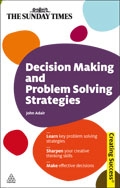
| • How to
approach problems
• How to argue your case
• How to sharpen your analytical skills
Paperback – 192 pages Reissue (7 June, 1985) Pan;
ISBN: 0330287486 |
|
|
|
£9.99 |
| This clear and
authoritative guide answers the questions, "what is strategic
leadership?", "what makes a person effective as
a strategic leader?" and "how can I develop my abilities
as a leader?" The concept of leadership is relevant not
only to organizational life but to all of us; everyone has
to 'lead' their own life. To be a strategic life-leader means
developing a vision and direction for one's life, identifying
personal core values and fostering an informal team among
colleagues and associates. 'Effective Strategic Leadership'
is as useful for unstructured careers as it is in large companies
or organizations.
Paperback- 345 pages (24 May, 2002) Macmillan;
ISBN: 0333906446 |
|
|
 |
|